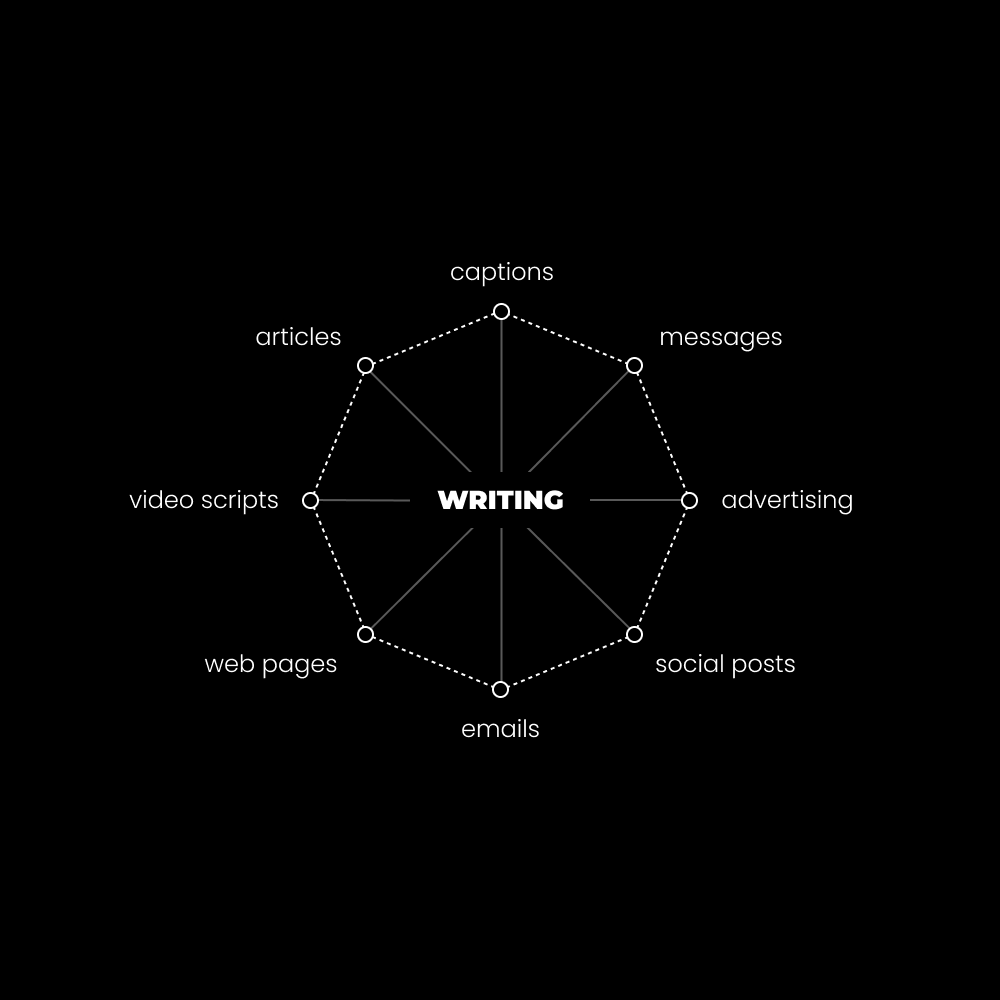
If you don't know what to learn in the age of AI, start writing. Not to become "a writer." Writing teaches you to think clearly, to learn any skill faster, and to attract an audience that will pay for your work. That last part matters the moment you want to build something instead of trading hours for a paycheck.
Thinking, learning, and distribution. Getting your ideas in front of people who might actually pay for them. Those three skills don't expire, and writing lets you practice all of them at once while building a compounding asset on the side.
I never planned to write for a living. I'm a big, blunt guy who fell for deep ideas, which is not the picture most people have of someone who does this. A morning habit changed the shape of my thinking and the size of my income. It calmed my head, opened doors the job market never did, and now pays the bills.
Two things here: the system I use to capture ideas and turn them into writing worth reading, and the reason this path works better today than at almost any point before it.
The leverage that built the last century's fortunes is disappearing
The biggest leverage is no longer capital. The biggest leverage is enterprise, the ability to run a great business. And in particular, the biggest leverage is personal brand. Having a big audience. As soon as you've got people paying attention to you, you have this enormous form of leverage. — Daniel Priestley
The rules of wealth creation have changed. Industrial-age assets (property, factories, machinery, physical goods) are giving way to digital ones: audience, personal brand, intellectual property, content, software. They're cheap to build. They scale. They're hard to tax, and they compound while you sleep.
The only thing standing between you and this kind of leverage is one good idea and the nerve to post it.
Most people still run on industrial-era assumptions. School, then a job, then retirement, sold to them as the safe route. It's one of the least safe options left.
Old leverage is physical and tangible: a house, a factory, a Rolex, a fleet of trucks, a warehouse of inventory, gold. You buy it and wait for it to appreciate or throw off income. It's also linear and local. A factory produces a fixed number of units a day. A house rents to one tenant at a time.
That doesn't make old leverage worthless. Leverage is leverage. But physical assets are the first thing governments find, tax, and seize when wages collapse, and that scenario is closer than it was a year ago. AI can wipe out wage income fast, which pushes governments toward expanded safety nets and the tax bases to fund them.
An email list of readers who know your work is much harder to seize. So is a library of essays, or a book that keeps selling on its own.
New leverage is intangible and digital: an audience, a personal brand, intellectual property, data, software. This is the leverage of the newly rich. Media, data, and code. A piece of writing gets created once and read by millions. Software gets built once and used by millions.
Writing is the most accessible and practical form of leverage available to most people. You can learn to code, but if nobody cares about the product you build, nobody uses it or pays for it. Writing is the leverage that unlocks every other form of leverage.
Digital assets don't show up on a balance sheet, yet they account for 90% of the S&P 500's value.
Kim Kardashian, Taylor Swift, Ryan Reynolds, MrBeast, Elon Musk. Every one of them carries a massive audience and personal brand as a core asset. You probably don't want their level of fame, and that's the good news, because you don't need millions of followers to make this work. Six to twelve months of focused effort can land you in a genuinely different life.
I replaced my income around 5,000 followers, about six months in, once I actually took it seriously. My friend Randy, a fitness coach, was making $100,000 a month at roughly 10,000 followers, because he studied marketing and sales and applied what he learned as if his life depended on it. It did.
People wildly overestimate how many followers they need to win. They compare themselves to the celebrities on their timeline, not to the much smaller crowd actually making a living this way. Finding your own personal monopoly and packaging content people read is a learnable skill. And the payoff runs well past follower counts and money.
Writing rebuilds how you think, not just how you communicate
How do I know what I think until I see what I say? — E.M. Forster
The act of writing changes how you experience the world. Conversations turn into material. Half-formed thoughts start hunting for their edges. You notice detail instead of skating across the surface of your own life. Four effects are worth naming.
It forces scattered thinking into a single line
Thinking without writing feels like walking through a forest where you can see in every direction. Writing is driving a road through that same forest. You decide where you're going, which turns to take, whether to detour, how to find your way back if you get lost.
Writing is the apparatus for thinking. It's the gym where the mind gets built.
You might feel like you understand your own feelings, counterarguments, memories, half-formed analogies, even your values and beliefs. Until you write them down, you don't. Not with any precision.
It sharpens what you notice
Write regularly and you build an external record of your own thinking, one you can reference to articulate today's thoughts with more clarity than you'd manage cold.
After a few years of serious practice, something like a photographer's eye kicks in. The world stops looking flat. You start seeing structure in an argument, a metaphor buried in a mundane moment, the narrative arc of an ordinary day. Writing trains a kind of attention that bleeds into everything else.
The strangest layer: you start catching ideas you'd otherwise have missed. When there's a newsletter planned for the week, your mind flags the material that fits it. Call it psycho-cybernetics. Your mind works like a heat-seeking missile aimed at its goals, surfacing the tools you need to hit them.
Most people miss this layer entirely. Not because they can't do it, but because they never chose their own goals. They inherited unconscious ones by default, and since the path was already mapped for them, showing up to school and work was enough.
It exposes what you don't actually understand
Most people believe they understand things they've never had to explain out loud. Not because they're unintelligent. Because they've never been forced to externalize a thought and look at it honestly.
Writing is a communication tool. It's also a test: it shows whether you actually know what you're talking about.
That exposure is exactly what people avoid. They want ideas to arrive fully formed. They treat writing as something everyone already knows how to do, so they never invest in it as a skill the way they'd invest in any other.
It compresses how fast you learn
The future belongs to whoever learns the fastest. Most people quit learning the day they leave school, and it shows. Any goal outside the handful society hands you at birth demands self-education, and writing is what speeds that education up.
Writing is teaching and understanding at once. Learning science calls the mechanism the protégé effect: students who teach material retain it better than students who only study it.
The cognitive load required to figure out how to explain something to someone else forces deeper processing, better organization, and identification of gaps in knowledge.
I learned more in my first six months of writing online than in years of school, at least about the things I actually cared about. I could feel my thinking change shape.
Then comes the real test. You read something. You feel like you get it. You try to write about it. You can't.
Most people decide they aren't "qualified" to write about the topic. That's not the problem. They're building invisible gatekeepers out of fear of putting their ideas in front of other people. Nobody needs a credential to write about an idea. Once you see exactly where your understanding breaks, you go back, research, and keep writing.
A system for turning scattered ideas into writing people actually read
I've never been organized. I tried the second-brain apps. I tried running everything through AI tools. I always ended up back at one long-running note.
Ideas get lost this way, and that's fine. If you need to remember it, it wasn't important. If it's important, you'll remember it.
Writing that gains traction, instead of vanishing into a black hole nobody notices, tends to need the same five things:
- One topic or theme for the week
- A place to jot ideas down fast
- A way to capture inspiration: social posts, videos, articles
- A sense of how to package the hook or title so people actually want to read it
- A way to pull from your ideas, inspiration, and research while you write
Here's what that looks like in practice.
Choosing what to write about
Forget niching down. You're not a lion that dies when you get moved to Alaska. You're a human who learns and adapts and does fine in any environment.
Two questions govern every topic. First: is it something I find worth sharing? Filter an idea through your own perspective without overthinking it into oblivion and it becomes unique by default. You have a specific identity. You won't reach everyone, and trying to will dilute the people you could actually reach.
Second: is it framed in a way that grabs attention? That's the job. You earn attention or your writing doesn't get read, and you earn it by studying what already works on social media and applying that structure to your own hook and title.
That's social growth in a nutshell, and it's where most people quit without noticing. They want to feel like pure, uncompromising creative writers, so they refuse to package their ideas the way the market wants. Their work never gets traction. They never get paid. They keep grinding on someone else's goals so their boss gets paid instead. They want to reach people badly, then resist the one skill that would let them, treating packaging as a betrayal of identity rather than a skill that makes them more useful to readers.
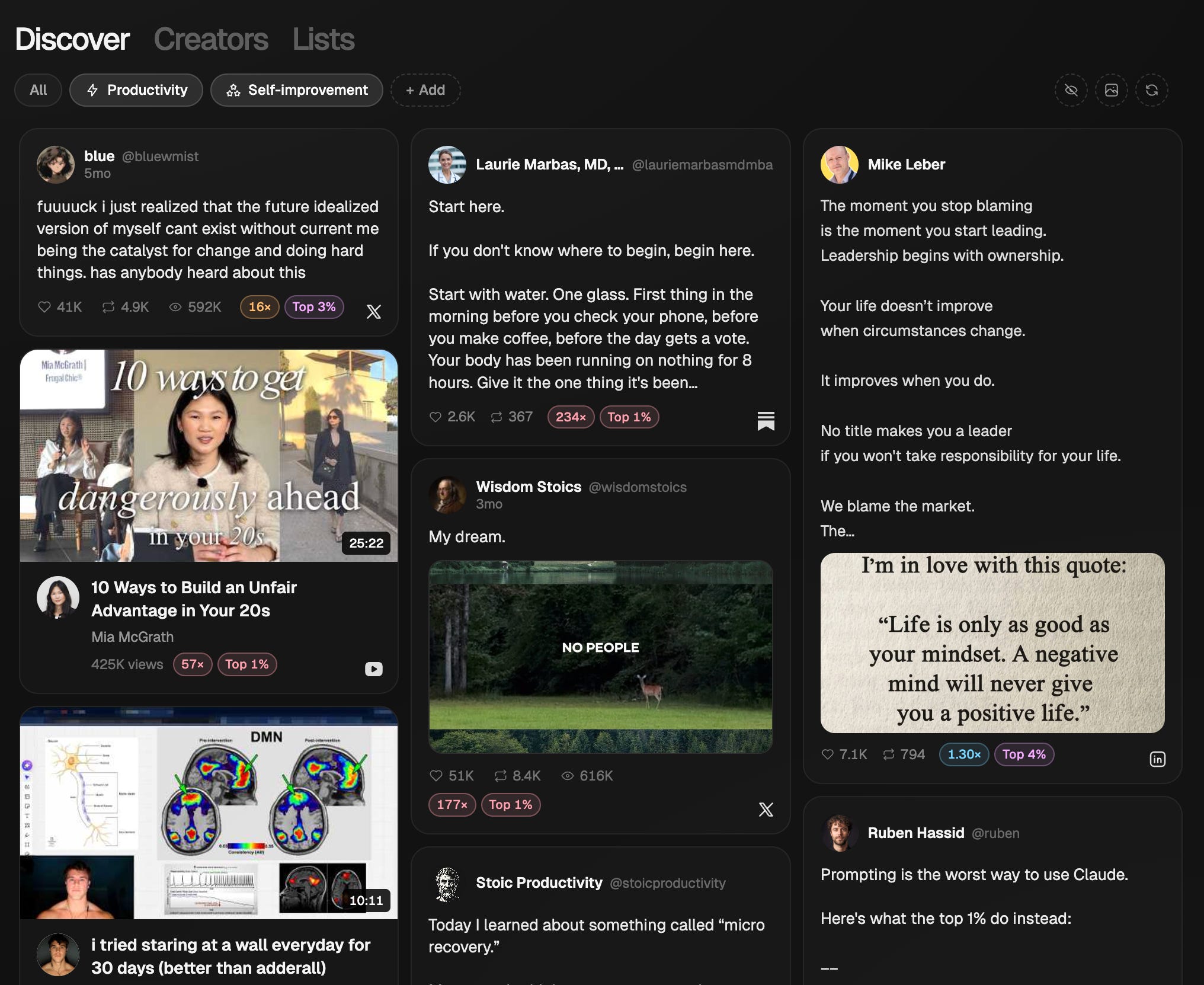
So before you write, research what's working on social media. It shows you what the market is already paying attention to. Scroll and save posts that are performing, or use a research tool that pulls top posts into one place.
This piece is a working example. The title borrows structure from a post I'd already saved, something like "The Notebook System That Saved My Brain," merged with the topic I actually wanted to write about. The market had signaled what it wanted. I aimed my own idea at that signal.
One project, one week, every platform
One newsletter goes out per week. That single long-form piece becomes an X article, a soft YouTube script, and episodes across every podcast platform.
Twice a week looked more productive on paper. The thinking got worse, not better. My brain works best with time to gather inspiration around one topic at a time.
The whole week orbits that topic. A book throws up a relevant idea. A YouTube video does the same. All of it becomes research, and the newsletter becomes the source for every other platform's content that week. One piece a week, feeding everything. My thinking stopped being scattered the moment I stopped scattering it.
In practice: create one place, once a week, to save ideas to.
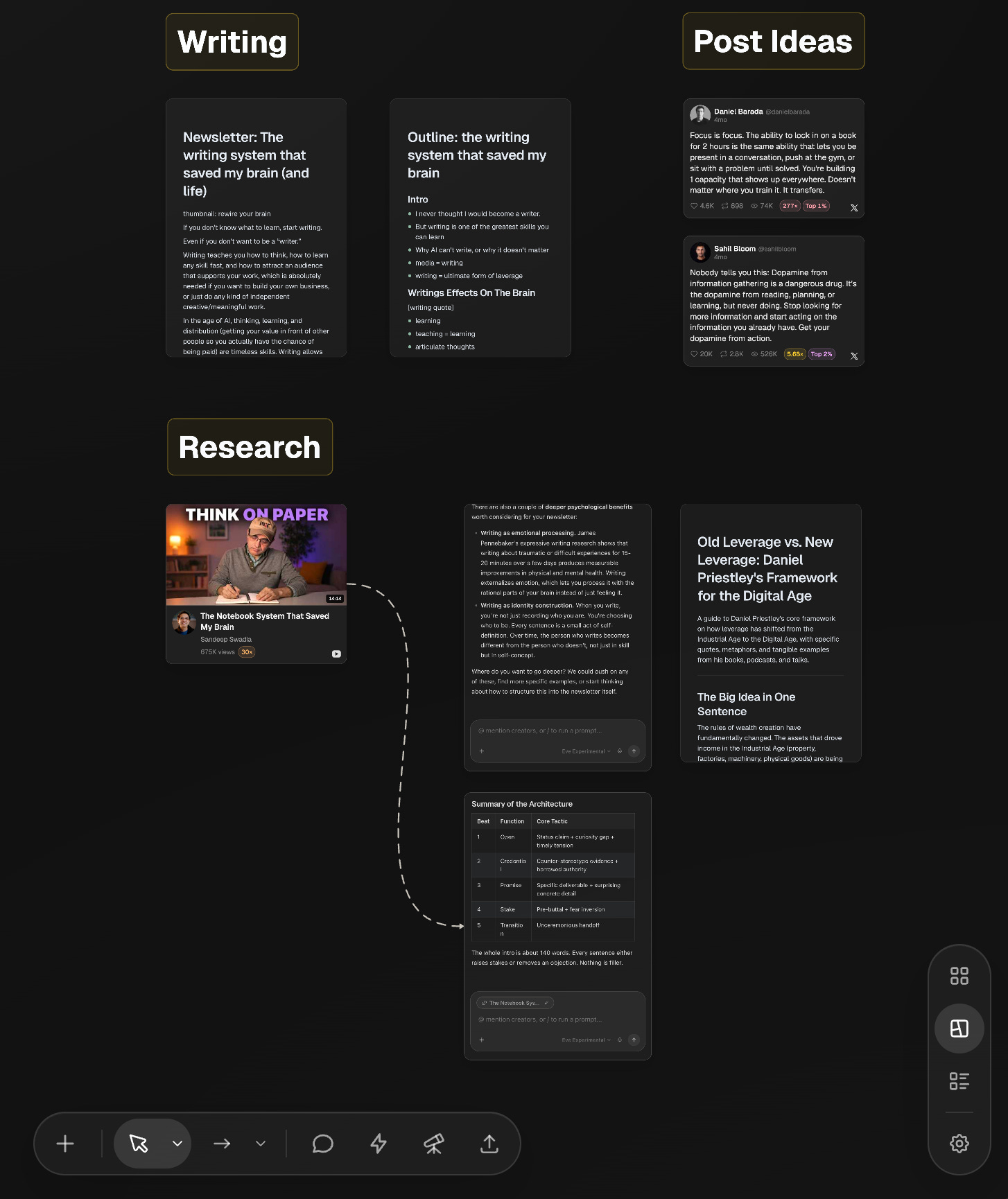
I keep a single board where I drop notes, paste social links, add articles and videos, and upload books as PDFs so an AI tool can pull the relevant ideas out instead of me highlighting passages by hand. I'm writing this in that board right now. It stays open while I write, or I open a chat connected to a saved post, PDF, or link and pull the idea straight out. Anything I catch away from the desk, a YouTube video watched on my phone, gets saved to the same board and mined later.
Three more boards round it out. Favorite Ideas, for posts I love. Validated Ideas, for posts that already went viral. Personal Ideas, for my own notes and half-formed thoughts. A mix of all three produces a finished piece. Even the writers you admire research and save inspiration deliberately, then combine it into something new. Nobody writes from thin air.
Any of those boards can be chatted with directly for headline variations, angles, or post ideas that go straight into a scheduler.
Outline, write, repurpose
The writing process itself would take a bootcamp to cover properly. What matters here is the loop around it:
- Build a board to save posts, ideas, and videos: this is the research
- Build an outline document to organize the ideas
- Keep both open while writing
- Publish as a long-form post and an X article
- Block one hour a week to record it as a YouTube video, then push that video to every podcast platform
The article then generates post ideas through the rest of the week, and the original piece gets promoted a few times under other content so it keeps compounding.
That's the entire system.
Walking, reading, and about sixty minutes of writing a day. That's the foundation for three of the most durable skills left: learning, thinking, and earning independently. The habit is small. What it rewires is not.