
There's a moment when you walk into a truly great building—or sit in a perfectly designed car, or strap on a watch that just feels right—where you understand something beyond words. It's spiritual. Everything fits. Nothing is out of place. You don't have to think about whether a sink belongs there or if a color makes sense. You feel it.
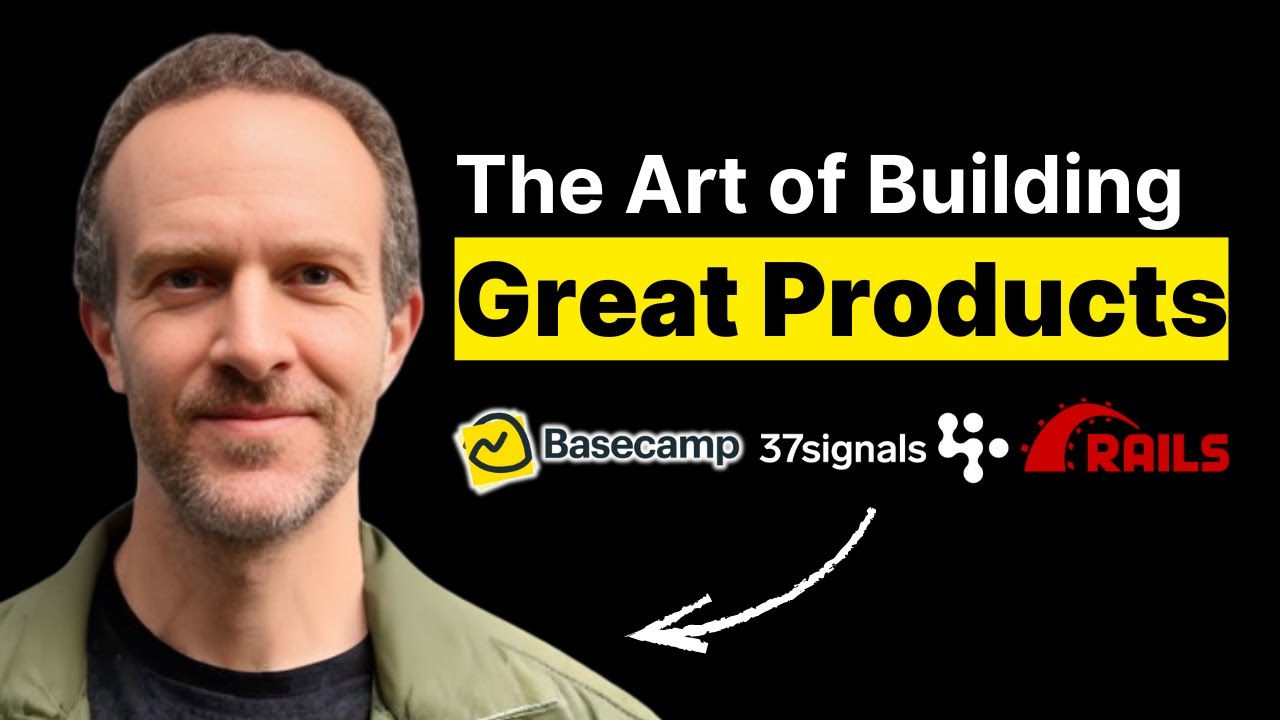
Jason Fried has been chasing that feeling for 26 years.
As the founder of 37signals—a company that makes tens of millions in profit annually—Fried has built products like Basecamp, HEY, and Ruby on Rails. But here's the thing: he's not that interested in running a business. He's interested in making products that are whole. Products where every piece matters because one person, or a small group of people, thought through every detail and made them all work together.
Where Great Design Actually Comes From
Fried's inspiration doesn't come from business books or design theory—it comes from architecture, watches, and cars. These domains teach you something crucial: there's a thousand ways to design the same thing, yet most fail because the designer didn't actually live with the decisions they made.
When you sit in a car where someone clearly thought through ergonomics by actually sitting in it, you feel the difference. When you walk into a Frank Lloyd Wright house, you can't remove the sink and replace it with a Home Depot model. You can't repaint the floor a different color. The entire structure is one coherent idea manifested in materials.
"You just get a feel for things that are a whole, a single piece, a single idea, a single concept executed so beautifully. It's a spiritual experience."
This is Christopher Alexander territory—the distinction between self-conscious design (architects making blueprints for people they'll never meet) and unself-conscious design (people building for themselves, with direct feedback loops and instant problem-solving). When you build something for yourself, you're forced to live with the consequences. That creates integrity.
The AI Paradox: Speed Without Soul
This distinction becomes crucial when you look at AI's current impact on product development. Yes, you can now build prototypes faster than ever. Yes, non-technical people can spin up working applications. The irony? This makes the problem worse in some ways.
Fried is skeptical about AI-generated products for others—not skeptical about AI itself, but about whether speed solves the real problem. Building something quickly for yourself is incredible. You live with the tradeoffs. You iterate based on your own frustrations. But building for others requires understanding edge cases, handling conditions you didn't anticipate, and sewing together a hundred small details so seamlessly that users never notice the seams.
That's the hard part. That's where the art lives.
When you hand off work to AI because it's faster, you're outsourcing the judgment. And judgment—the accumulated wisdom of someone who understands the full system—is irreplaceable. At Every, Dan Shipper's company, they've found that professional developers using AI tools can build sophisticated products, but they're using AI as a substrate for thinking, not as a replacement for it. They're writing in English about implementation details, essentially pseudo-code, and that's where the real programming happens.
But most products being built with AI right now? They're being optimized for speed, not coherence.
The Business Myth That Kills Good Products
Fried's biggest realization after 26 years is that he doesn't care about business. He cares about making things. The business is the vessel that allows products to exist—necessary infrastructure, not the point.
This matters because it contradicts a widespread assumption: as companies grow, you need to separate layers. You need someone running the business while you run products. You need professional managers and business people doing business things.
Here's what Fried learned: at small companies, this separation kills the thing you're trying to build.
There is no difference between how you run the business and what you build. It's not layers you laminate together—it's one piece of material. When Basecamp was built a certain way, when Ruby on Rails was designed a certain way, when HEY was conceived—those weren't just product decisions. They were business decisions, cultural decisions, operational decisions. They were all the same decision.
This is why every attempt 37signals made to hire a COO and have someone else "run the business" while leadership focused on product failed. The business is the product. The way you operate is what you're making.
Staying True to You Is the Only Sustainable Advantage
The worst mistakes Fried made came from doing things because he thought he should. Not because they were right for 37signals, but because someone told him that's what professional companies do.
When you start something, you're starting it because you think differently. You see something others don't. The moment you stop thinking differently—the moment you start "professionaling" your operation—you've surrendered the only advantage you have.
Shipper, running Every at a similar scale and with a similar philosophy, made the same mistake: he stopped writing because he thought a CEO shouldn't do individual contributor work. Two years of flatness followed. Then he realized the writing was the business. The products emerged from thinking deeply about AI. The ideas came from writing about them. The company's culture came from both happening simultaneously.
The companies that look differentiated in 2026 are the ones that refuse to look like everyone else. And the only way to look different is to stay obsessively, unapologetically yourself. Not yourself once you've been smoothed by professional advisors and external expectations, but actually you.
The Spiritual North Star
What Fried keeps returning to—through Frank Lloyd Wright, Christopher Alexander, vintage watches, and handmade buildings—is the idea of wholeness. A thing that can't be pulled apart without breaking. A thing where every element serves the whole. A thing that was made by someone who understood it completely, because they built it for themselves first.
This is harder than ever to find now. Most software interfaces look identical—sidebars on the left, content in the middle, buttons arranged the same way. Most websites are templates. Most products are collections of features bolted together because market research said people wanted them.
That's not wholeness. That's assembly.
The best companies don't optimize for speed or scale or venture capital approval. They optimize for a feeling. And that feeling only emerges when one person, or a small group of people who think alike, builds something completely because they understand what complete means.
You can't AI-generate that. You can't hire that. You can't copy it from a framework. You have to be it, from the inside out.
After 26 years, that's what Fried wants to tell you: don't break apart what you've built. Don't apologize for the way you think. Don't separate yourself from the work because someone told you that's how real companies operate.
Build something whole. Build something that couldn't be any other way. Build it for yourself first, and then share it.
That's the only thing that lasts.